
Replies
What Plotti writes when the player acts, and how to brief her.
A reply is what Plotti writes in answer to the player: the barkeep's answer to a question, the narration after a choice. You give each reply a brief, and Plotti writes from it every time the reply is used.


Where replies live
All of a story's replies are in the Replies panel in the left rail. Add a reply asks for a name and a kind:
- Lines: characters' lines and narration, as in a visual novel. The most common kind.
- Prose: a passage of prose.
- Fills in fields and Rule a check: for execute nodes and checks.
You can also make a reply where it is used. In an interaction's Turn, click the input box or an option, then under Reply, pick a reply with Use, or click Write a new one.
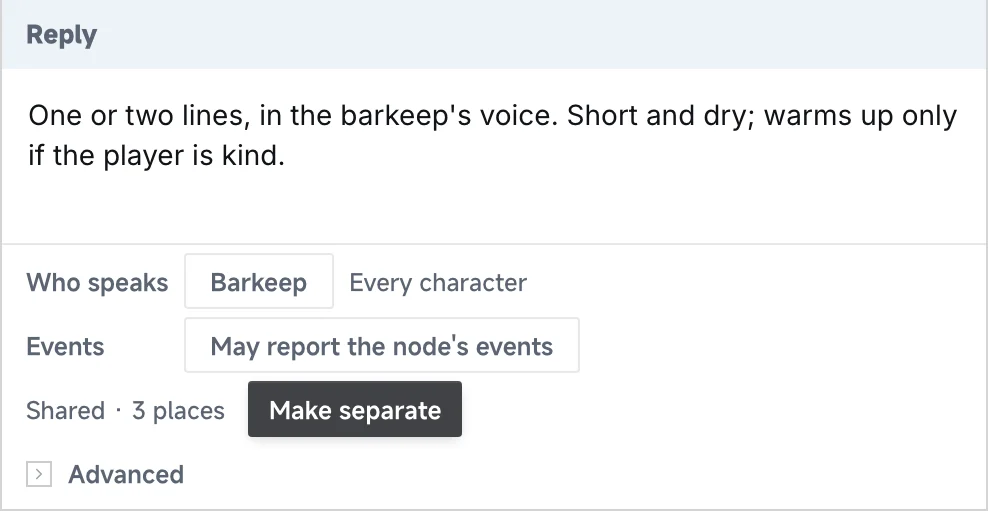
A reply's settings
The settings have three parts:
- Brief for Plotti: the instruction (below).
- What comes back: for Lines, Who speaks (the characters that may speak; with none picked, Every character may) and Events (May report the node's events, see Events). Under Advanced: Max lines, Stage words and Suggestions per answer.
- Used in: every place that uses this reply.
Stage words are the stage changes Plotti may make while she writes, such as bringing someone on or changing a face. Suggestions per answer (0 to 8) lets her offer the player up to that many lines to send next; 0 turns them off.
Shared replies
One reply can serve several places. Its form then says Shared · 3 places, and a change to it changes all of them. Make separate gives this place a copy of its own.
Writing a brief
The brief tells Plotti what to write here. A good brief says:
- what to write and how long: "Two or three lines from the barkeep.";
- where to stop: usually at the player's next decision. "Stop once she has answered; don't move the scene on.";
- what not to write: "She never says who left the letter.";
- what the player's words already settled: if the player has paid, that is settled, and Plotti should not undo it.
Other things belong elsewhere:
- How a character talks goes in How they speak on the character sheet, so every reply uses it. See Characters and the world book.
- An outcome that must happen goes in an event or a check, not only in the brief.
- Narration always calls the player "you"; don't ask for the third person.
Write the brief in the language the story is written in.
Replies and variables
A reply cannot change variables on its own. A reply changes the story through the events it reports, and you write those events' effects. The one exception is a character's field with How it changes filled in: Plotti keeps it up to date as she writes. See Variables.